Semaglutide for MASH: What the ESSENCE Trial Showed and Who the Approval Covers
Semaglutide and MASH explained: ESSENCE trial results, what the approval covers, what remains unknown, safety warnings and how to obtain it safely.

In this article
- First, the Terminology: MASLD, MASH and Fibrosis
- Who Is More Likely to Develop MASH?
- How Doctors Assess Fibrosis Without Always Needing a Biopsy
- What Semaglutide Is and Why It Was Studied in MASH
- Semaglutide and MASH: What the ESSENCE Trial Found
- What the U.S. Approval Covers, and What It Does Not
- What We Still Do Not Know
- Safety: The Other Half of the Conversation
- Getting Semaglutide Safely: A Pharmacy Perspective
- Why Accelerated Approval Matters to Patients
- Lifestyle Still Matters
- How Semaglutide’s Other Trials Fit In
- Questions to Bring to Your Doctor
- Common Misunderstandings
- The Bottom Line
- Frequently Asked Questions
Straight answer
Semaglutide has shown a meaningful benefit in MASH, the inflammatory form of metabolic fatty liver disease. In the phase 3 ESSENCE trial, MASH resolved without worsening fibrosis in 62.9% of people on semaglutide versus 34.3% on placebo at 72 weeks. The U.S. approval for this use is narrow: adults with noncirrhotic MASH and moderate to advanced fibrosis (F2 to F3), alongside diet and exercise. It does not cover every fatty liver diagnosis.
Few medicines have generated as many headlines in recent years as semaglutide. First known for type 2 diabetes and then for weight management, it has now been studied in a liver condition that affects a large number of adults and, until recently, had no approved drug treatment at all. If you or a family member has been told you have fatty liver, you may be wondering whether semaglutide is relevant to you.
The answer depends heavily on details. “Fatty liver” covers a range of conditions, from simple fat build-up to inflammation and scarring. The evidence for semaglutide applies to a specific stage, studied in a specific way, with specific outcomes measured. This article walks through the terminology, the ESSENCE trial results, what the approval covers and what it does not, the safety picture, and practical questions to bring to your doctor or pharmacist.
First, the Terminology: MASLD, MASH and Fibrosis
Liver doctors updated their vocabulary in recent years, which is why older and newer terms both appear online. The National Institute of Diabetes and Digestive and Kidney Diseases explains in its definitions and facts on fatty liver disease and MASH that the condition formerly called nonalcoholic fatty liver disease, or NAFLD, is now commonly called metabolic dysfunction-associated steatotic liver disease, or MASLD. The more serious inflammatory form, formerly NASH, is now MASH, short for metabolic dysfunction-associated steatohepatitis.
Here is how the stages relate to each other:
MASLD (fatty liver): fat builds up in the liver, typically linked to metabolic risk factors such as excess body weight, type 2 diabetes, high blood pressure or abnormal cholesterol.
MASH: fat plus inflammation and injury to liver cells. Not everyone with MASLD develops MASH.
Fibrosis: scar tissue that can form as liver damage continues. Doctors grade it in stages, commonly F0 (no scarring) through F4.
Cirrhosis: advanced, extensive scarring (stage F4) that can affect how the liver works and raises the risk of serious complications.
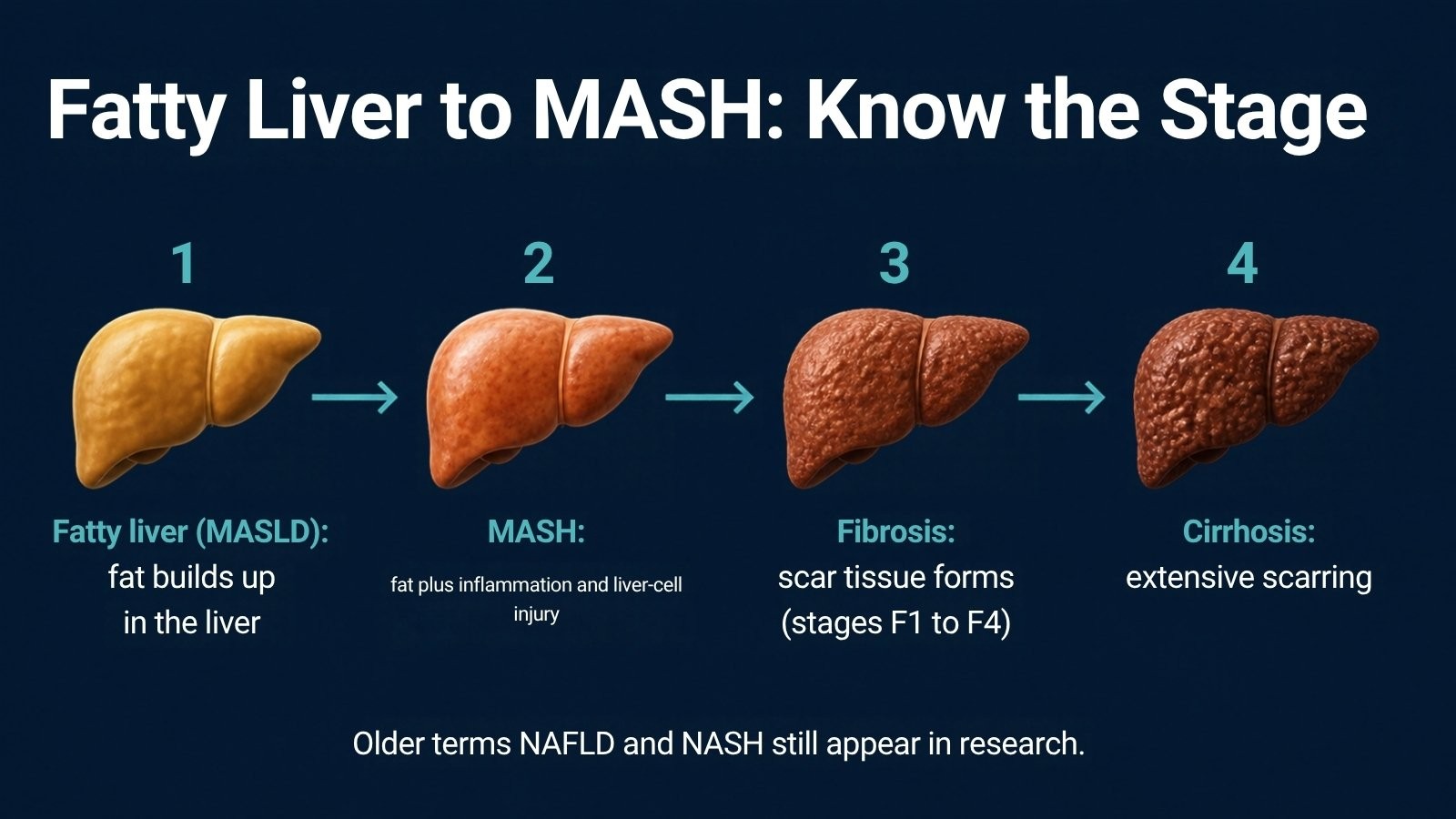
This distinction is the single most important point in this article. Someone whose ultrasound shows fat in the liver does not automatically have MASH, and someone with MASH does not automatically have the degree of fibrosis studied in the semaglutide trial. Working out the stage requires a clinician, appropriate testing and sometimes a liver biopsy. NIDDK’s guidance on how doctors diagnose fatty liver disease and MASH describes the history, blood tests, imaging and biopsy that may be involved.
This short explainer from Yale Medicine’s fatty liver program covers how MASH develops, why it often has no symptoms, and why early identification matters:
Who Is More Likely to Develop MASH?
MASLD and MASH are closely linked to metabolic health. People living with obesity, type 2 diabetes, high blood pressure, high triglycerides or low HDL cholesterol are more likely to develop fatty liver disease, and those with several of these factors together face higher risk of progressing to MASH and fibrosis. The condition can also occur in people who are not overweight, which is one reason doctors look at the whole metabolic picture rather than body weight alone.
Because MASH often causes no symptoms until it is advanced, many people learn about it only after an abnormal liver blood test or an imaging scan done for another reason. If you have type 2 diabetes or several metabolic risk factors, it is reasonable to ask your doctor whether your liver health has been assessed.
How Doctors Assess Fibrosis Without Always Needing a Biopsy
Liver biopsy remains the reference standard for confirming MASH and grading fibrosis, and it is what the ESSENCE trial used. In everyday practice, though, doctors often start with less invasive tools. These include scores calculated from routine blood tests and age, and imaging methods that estimate liver stiffness, since scarred liver tissue is stiffer than healthy tissue. Results from these tests help decide who is likely to have significant fibrosis and who may need specialist referral or further testing.
For patients, the practical point is that “you have fatty liver” is rarely the end of the assessment. Asking what your fibrosis stage is, and how it was estimated, is the step that tells you whether trial evidence like ESSENCE is relevant to you.
What Semaglutide Is and Why It Was Studied in MASH
Semaglutide is a GLP-1 receptor agonist, an engineered peptide medicine modelled on a natural gut hormone called glucagon-like peptide-1. Its designers modified the natural hormone’s structure so that it lasts much longer in the body, which allows once-weekly injections. It is available under different brand names for different approved uses, which is an important detail we will return to.
Researchers studied semaglutide in MASH for a straightforward reason. MASH is closely tied to metabolic health, and semaglutide affects several of the same drivers: it lowers blood sugar in people with type 2 diabetes and leads to significant weight loss in many people. Weight loss itself is known to help fatty liver disease. The question was whether semaglutide would produce measurable improvements in the liver tissue of people with MASH and significant scarring.
Semaglutide and MASH: What the ESSENCE Trial Found
ESSENCE is a randomized, placebo-controlled phase 3 trial funded by the manufacturer, Novo Nordisk. Its interim results were published in the New England Journal of Medicine in a paper titled Phase 3 Trial of Semaglutide in Metabolic Dysfunction-Associated Steatohepatitis. The published analysis followed the first 800 participants for 72 weeks. Every participant had biopsy-confirmed MASH with stage F2 or F3 fibrosis, meaning moderate to advanced scarring but not cirrhosis.
The trial looked at two main biopsy outcomes:
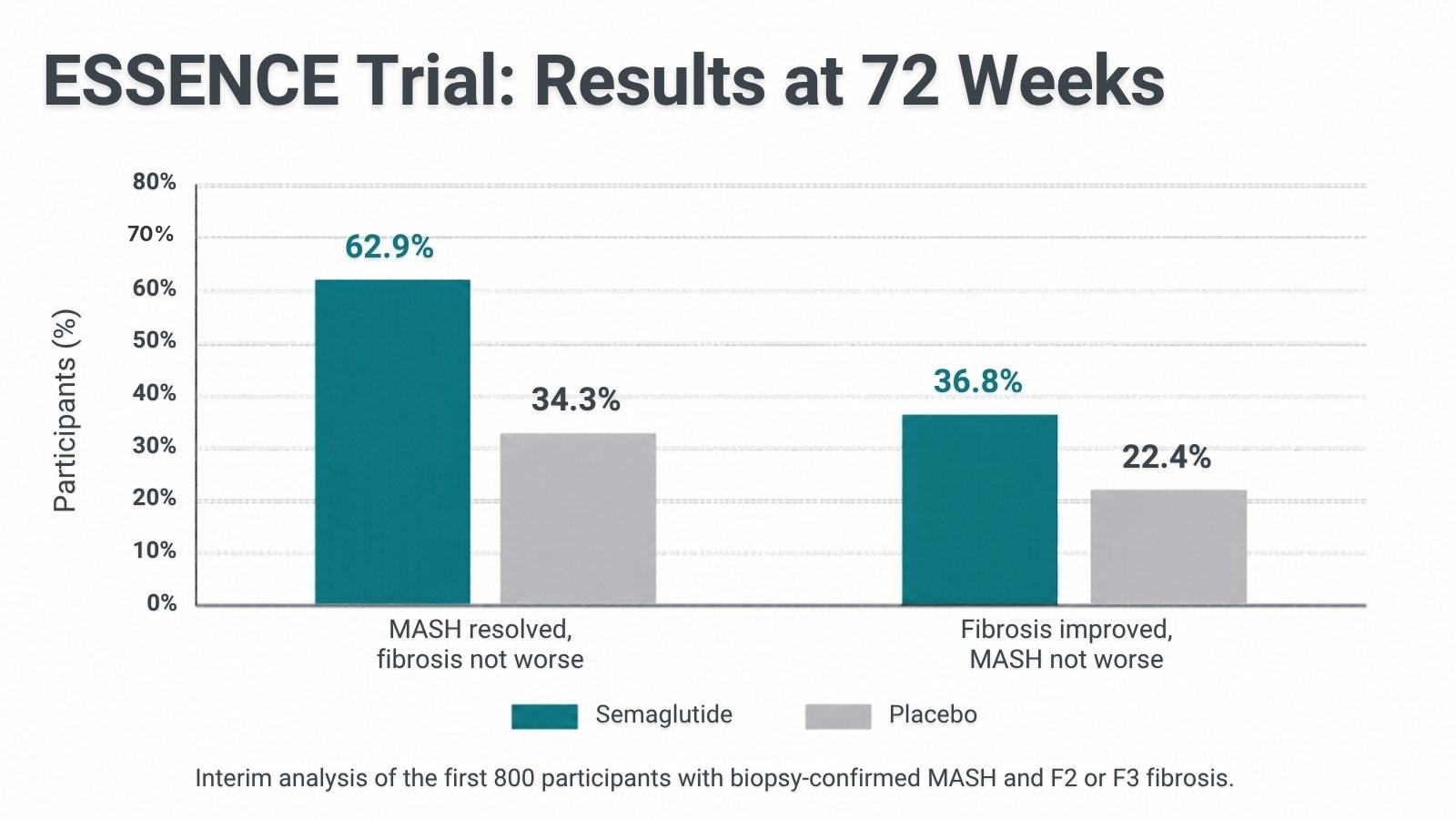
| Outcome at 72 weeks | Semaglutide | Placebo | What it means in plain terms |
|---|---|---|---|
| MASH resolved without fibrosis getting worse | 62.9% | 34.3% | The inflammation and cell injury that define MASH were no longer seen on biopsy, and scarring did not progress |
| Fibrosis improved without MASH getting worse | 36.8% | 22.4% | Scarring improved by at least one stage on biopsy, without the inflammation worsening |
Two points help put these numbers in context. First, the fibrosis result amounts to roughly 14 additional people per 100 meeting that biopsy endpoint compared with placebo. Second, an improvement in fibrosis stage is not the same as all scarring disappearing. As The Peptides Blog explains in its detailed review of what ESSENCE found for semaglutide in fatty liver, 36.8% does not mean that more than a third of participants had their liver scarring reversed completely.
Placebo results deserve a word too. A third of people on placebo also saw MASH resolve. Trial participants usually receive lifestyle counselling, and the act of being in a monitored study often encourages healthier habits. That is exactly why placebo-controlled trials matter: they show how much of the improvement can be attributed to the medicine itself.
What the U.S. Approval Covers, and What It Does Not
Based on these liver results, FDA granted the Wegovy brand of semaglutide injection an additional indication for MASH through the accelerated approval pathway. Accelerated approval allows a medicine to be approved on the basis of an outcome, here improvement in liver tissue on biopsy, that is reasonably likely to predict real clinical benefit. Continued approval may depend on later confirmation that the medicine improves outcomes such as liver-related complications.
According to the prescribing information, the indication covers adults with noncirrhotic MASH and moderate to advanced fibrosis, stages F2 to F3, used together with a reduced-calorie diet and increased physical activity.
That wording rules a lot out. The approval does not cover:
People with simple fatty liver who do not have MASH.
People with MASH but little or no fibrosis. The trial studied F2 and F3 only.
People with cirrhosis. ESSENCE excluded cirrhosis, so the results cannot be applied to that stage.
Every semaglutide product. Semaglutide is sold under different brand names for different approved uses. The MASH indication belongs to the specific product and population named in its label.
Products sold as research peptides or unverified “semaglutide.” Products sold outside the regulated pharmacy system are not the approved medicine and are not covered by the trial evidence. The Peptides Blog’s guide to telling approved medicines apart from research-only and compounded peptides explains why these categories should never be blurred.
Semaglutide was not the first medicine approved for MASH. Resmetirom, an oral medicine that works through a different mechanism, received accelerated approval in 2024 for adults with noncirrhotic MASH and moderate to advanced fibrosis. Having more than one approved option means treatment decisions can be tailored, which is another reason to have a detailed conversation with a liver specialist.
What We Still Do Not Know
The 72-week ESSENCE analysis shows a benefit in liver tissue. It does not yet show fewer liver transplants, fewer cases of cirrhosis, fewer liver cancers or fewer deaths. Those are the outcomes patients ultimately care about, and they take years to measure. ESSENCE was designed to continue for 240 weeks precisely to look at longer-term clinical outcomes.
There is also an open question about how semaglutide helps the liver. Participants on semaglutide lost weight, and weight loss improves fatty liver disease. The trial results do not let us cleanly separate a direct effect on the liver from the effect of weight loss. That does not change the practical finding, but it matters for understanding the biology.
Finally, trial participants are carefully selected and closely monitored. Real-world results can differ, particularly in people with other health conditions or who take many medicines.
Safety: The Other Half of the Conversation
Every medicine with real effects carries real risks, and semaglutide is no exception. In ESSENCE, gastrointestinal side effects such as nausea, diarrhea, constipation and vomiting were more common with semaglutide than with placebo. These effects are well known across semaglutide’s uses and are often most noticeable when the dose is being increased.
The prescribing information also includes important warnings. It carries a boxed warning about thyroid C-cell tumors that were seen in rodent studies; whether this risk applies to humans is not known. The medicine should not be used by people with a personal or family history of medullary thyroid carcinoma or with multiple endocrine neoplasia syndrome type 2. Other warnings include pancreatitis and gallbladder problems, among others listed in the label.
For these reasons, semaglutide for MASH is a prescription decision made with a clinician who knows your full history. It is not something to source or self-manage.
Getting Semaglutide Safely: A Pharmacy Perspective
High demand for GLP-1 medicines has created a crowded and sometimes confusing marketplace. As a pharmacy information site, we see this question often, so it is worth being direct.
Use a licensed prescriber and a licensed pharmacy. Our guide on how to buy prescription medicines online safely covers how to check that an online pharmacy is properly licensed and requires a valid prescription.
Know what you are being dispensed. Check whether you are receiving the branded approved product, a generic where one exists, or a compounded preparation. These are not interchangeable from a regulatory standpoint. Our explainer on generic and brand-name medicines covers how equivalence works for approved products.
Avoid “research use only” products entirely. Vials sold as research chemicals are not approved medicines, carry no verified quality standards and are not covered by any of the trial evidence discussed here.
Ask your pharmacist. Pharmacists can explain how to use the injection pen, how to store it, what side effects to watch for and how semaglutide interacts with your other medicines.
Why Accelerated Approval Matters to Patients
Accelerated approval exists so that promising medicines for serious conditions can reach patients sooner, based on an early marker that is reasonably likely to predict real benefit. The trade-off is that some uncertainty remains at the time of approval. For semaglutide in MASH, the marker is liver tissue improvement on biopsy, and the confirmation still to come concerns hard outcomes such as cirrhosis and liver-related events. Knowing this helps set realistic expectations and explains why ongoing monitoring with your care team is part of treatment.
Lifestyle Still Matters
The MASH indication specifies use alongside a reduced-calorie diet and increased physical activity, and that wording is not a formality. Weight reduction, better blood sugar control, regular physical activity and limiting alcohol all support liver health, whether or not a medicine is part of the plan. For many people with earlier-stage fatty liver disease, these steps are the main treatment.
Managing related conditions, including type 2 diabetes, high blood pressure and high cholesterol, is also part of protecting the liver. People with MASLD often have higher cardiovascular risk as well, so the benefits of metabolic care extend beyond the liver.
How Semaglutide’s Other Trials Fit In
Semaglutide has been tested in several large trials with different populations and outcomes, and it is easy to blur them together in headlines. ESSENCE looked at liver tissue in people with MASH. Other trials have examined heart outcomes and kidney outcomes in different patient groups. The Peptides Blog keeps these separate in its evidence reviews, including its summary of the FLOW trial on semaglutide and kidney disease. Each trial adds a specific piece of evidence for a specific population, and none of them automatically extends to the others.
Questions to Bring to Your Doctor
If you have been diagnosed with fatty liver disease and are wondering about semaglutide, these questions can make your appointment more productive:
Do I have simple fatty liver, or MASH? Has my fibrosis stage been assessed, and how? Am I in the F2 to F3 range that the trial studied? Do I have any signs of cirrhosis? Are there reasons semaglutide would not be safe for me, such as my thyroid history or a past episode of pancreatitis? How would we measure whether treatment is helping? What lifestyle changes should come first or alongside? Would resmetirom or another approach be more suitable in my case?
You might also ask whether a referral to a hepatologist, a liver specialist, makes sense. Staging and treatment decisions in MASH often benefit from specialist input.
Common Misunderstandings
“Semaglutide is approved for fatty liver.” It is approved for a specific subset: adults with noncirrhotic MASH and F2 to F3 fibrosis. That is narrower than fatty liver in general.
“The trial showed it reverses liver scarring.” It showed that more people on semaglutide had fibrosis improve by at least one stage. That is meaningful, but it is not the same as reversing all scarring.
“It prevents cirrhosis and liver failure.” That has not yet been shown. Longer-term follow-up is designed to answer this.
“Any semaglutide product will do the same thing.” The evidence and approval apply to the studied and approved product. Unregulated products are not equivalent.
“I can skip diet and exercise if I take it.” The approval specifies use alongside lifestyle changes, and those changes remain central to liver health.
The Bottom Line
The ESSENCE trial is genuinely good news for a defined group of people with MASH and moderate to advanced liver scarring. It shows that a well studied peptide medicine can improve liver tissue in a way placebo does not, and it has led to an approved treatment option. At the same time, the evidence has clear edges: it applies to a specific disease stage, a specific product and outcomes measured on biopsy rather than long-term health events. Understanding those edges is what lets patients and doctors make good decisions together.
For clear, sourced summaries of the major trials behind peptide medicines, explore peptide benefits and the research behind them at The Peptides Blog’s clinical trial explainers, an independent educational publication that links to original studies and does not sell medicines or offer consultations.
Frequently Asked Questions
Is semaglutide approved for MASH?
Yes, for a specific group. The Wegovy brand of semaglutide received accelerated approval for adults with noncirrhotic MASH and moderate to advanced liver fibrosis (stages F2 to F3), used with a reduced-calorie diet and increased physical activity.
What did the ESSENCE trial show?
At 72 weeks, MASH resolved without worsening fibrosis in 62.9% of people on semaglutide versus 34.3% on placebo, and fibrosis improved without worsening MASH in 36.8% versus 22.4%. These were interim results in the first 800 participants.
Does semaglutide help simple fatty liver?
The approval and the ESSENCE results apply to MASH with F2 to F3 fibrosis, not to simple fatty liver. Whether semaglutide is appropriate for someone with earlier-stage disease is a question for their clinician.
Can semaglutide be used if I have cirrhosis?
ESSENCE excluded people with cirrhosis, and the MASH indication is for noncirrhotic disease. Treatment decisions in cirrhosis should be made with a liver specialist.
What are the main side effects of semaglutide?
Gastrointestinal effects such as nausea, diarrhea, vomiting and constipation are the most common. The label also includes a boxed warning about thyroid C-cell tumors seen in rodents and warnings including pancreatitis and gallbladder disease.
Is it safe to buy semaglutide labelled for research?
No. Research-labelled products are not approved medicines, have no verified quality standards and are not covered by the clinical trial evidence. Use a licensed prescriber and pharmacy.
Medical and legal disclaimer
This article provides general educational information about published research and regulatory status. It is not medical advice, does not recommend any medicine, and is not a substitute for diagnosis or treatment by a licensed clinician. Do not start, stop or change any medication based on this content.
Semaglutide is a prescription medicine with significant risks and should only be used under medical supervision and dispensed by a licensed pharmacy. Approved uses, labelling and availability vary by country and can change. Always read the current prescribing information and consult your doctor or pharmacist about your own situation.

Gertrude Sanders
More articles by this author